Select Uses and Benefits of AI
AI Usage Patterns
At the beginning of the survey, participants were shown a series of yes/no questions about whether they had used AI for various purposes. The following graph illustrates similarities and differences in usage patterns between participants with and without disabilities. As expected, greater percentages of disabled than nondisabled participants reported using AI for visual descriptions and captions. High percentages of both participant groups used voice-activated AI, AI for notetaking and writing, and AI in the workplace. Finally, although this is not a direct indicator of AI usage, far more disabled than nondisabled participants reported a recent healthcare denial, which will be discussed later.
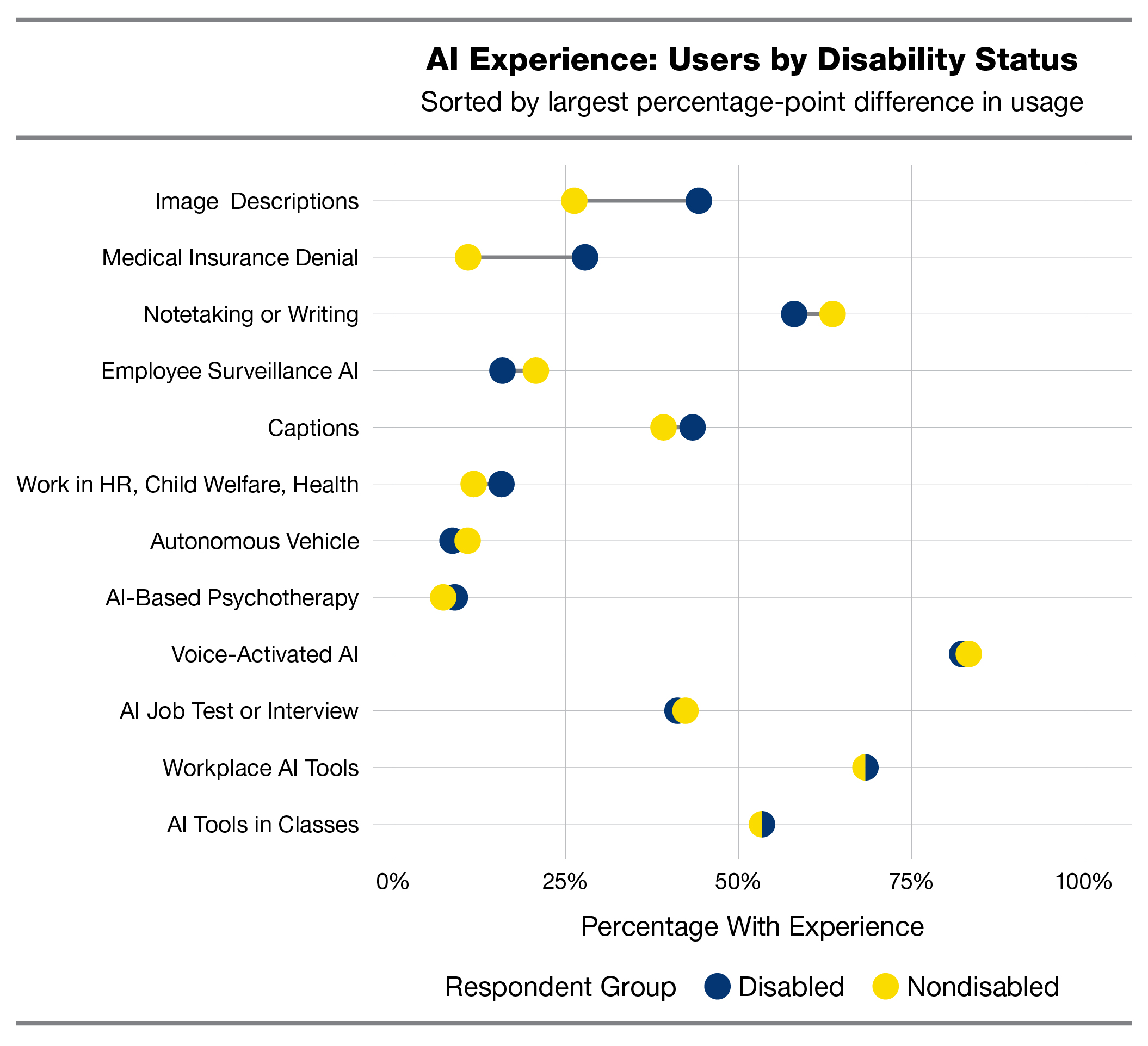
Some age and gender differences in AI usage frequency also emerged. Gen Z participants and Millennials were more likely to use AI for notetaking and writing (71% of Gen Z and 65% of Millennials) compared to older cohorts (61% of Gen X and 43% of older adults). More men used AI for visual descriptions (44%) compared to 36% of women and 24% of other genders. No other gender or age differences were observed.
Voice-Activated AI
Eighty-eight percent of participants reported using voice-activated AI (VAI), making it the most frequently used form of AI in our findings. The most commonly used voice-activated systems included Siri, Alexa, and Google Assistant. Participants who reported using VAI were asked follow-up questions regarding frequency of use and the specific tasks for which they used these systems.
Overall, disabled and nondisabled participants reported using VAI at similar rates. However, disabled participants tended to use VAI for a wider range of tasks. For example, disabled participants were more likely than nondisabled participants to use VAI to access news or weather reports, play games, and start or stop routines. However, disabled participants were no more likely than nondisabled participants to use VAI for controlling appliances.
When examining disability types, significant differences were observed between BLV and sighted VAI users. BLV participants were substantially more likely than sighted participants to use VAI for playing audiobooks or music (74% vs. 44%), playing games (25% vs. 8%), quickly searching the web (87% vs. 74%), accessing news or weather reports (69% vs. 43%), sending messages via dictation (82% vs. 54%), and starting or stopping routines (81% vs. 59%).
AI for Notetaking and Writing
AI was commonly used to help with notetaking and writing; specifically, 58% of disabled and 64% of nondisabled participants endorsed these uses. Participants who reported using AI for notetaking and writing were asked follow-up questions regarding the tools they use, frequency of use, perceived time-saving benefits, and perceived helpfulness of AI.
ChatGPT, Gemini, and Grammarly were the most commonly used tools for notetaking and writing. Generally, disability was not associated with task patterns or overall frequency of use. Regarding frequency, most participants did not use AI daily, instead reporting weekly or monthly use. Regardless of disability status, non-native English speakers were more likely than native English speakers to use AI for notetaking and writing at least once per week (48% vs. 29% respectively).
Time saving and perceived helpfulness emerged as key benefits of AI for notetaking and writing. Regardless of disability status, most participants believed that AI saves them time: 45% reported AI saving them “a lot of time” and 41% reported AI saving them “a little time.”. BLV users were somewhat more likely than sighted users to report that AI was extremely helpful for notetaking and writing (55% vs. 47%), and only 10% of BLV users rated this AI as “a little helpful” compared to 20% of sighted users.
AI in the Workplace
Our findings indicate that AI can have several benefits in the workplace. A total of 1,462 survey participants indicated that they were employed. Of these, 68% reported using AI at work, with no major differences based on disability status, age, or gender. All employed individuals who used AI at work were asked follow-up questions regarding which functions they used AI for and whether AI made their work easier or harder.
Overall, working people with and without disabilities, and working people across age and gender groups, used AI for many of the same things. The top three uses of AI at work for all participants, regardless of disability status, were writing (71%), research (63%), and note-taking (44%). 27% of participants reported using AI tools that were specific to their type of job. Participants were also provided space to elaborate on other ways they used AI at work that were not included in the response options. A number of participants reported using AI for translating between languages or for writing computer code, and a small number reported using plagiarism detection tools.
People with disabilities also reported using AI as assistive technology in the workplace. Specifically, 32% of disabled participants reported using visual description AI at work, and 25% reported using captions at work, compared to 13% and 14% of nondisabled participants, respectively. A small number of participants with disabilities elaborated on additional accessibility-related uses of AI, such as creating accessible materials.
Regarding whether AI made work easier or harder, 56% of participants reported that AI made their job easier, while 44% reported that it made their job harder. There were no major differences based on disability status.
AI Used in Education
The sample included 279 participants who had taken a course (either formal or informal) in the two years before taking the survey. Of these students, just over half (53%) reported using AI to assist with learning. Most of these students (77%) were taking college or university courses, while 55% were taking online courses, and 28% were using learning apps, like Coursera (students often chose multiple responses). When asked whether or not AI made their learning easier, 61% said yes, 27% were unsure, and 12% said no.
Participants who said that AI made learning easier were invited to elaborate on how AI helped them learn. Overall, participants with and without disabilities described using AI to summarize text and to better understand academic material; however, this use was more frequently reported by disabled participants. This was sometimes paired with the benefit of AI’s consistent availability, allowing participants to ask questions when professors or other humans were unavailable. For some participants, using AI in this way reduced the social cost of learning, as AI was described as a nonjudgmental and patient medium that did not become frustrated. One disabled participant elaborated on this usage:
“Mostly AI has helped me when I'm having trouble focusing and breaking the steps of an assignment into small manageable bits of work. It helps to have a partner/tutor who doesn't get impatient with me, who never tires of helping explain something to me, or never thinks I'm stupid when I need its help breaking something down into baby steps, for lack of better words. Humans all too often get frustrated with me, or seem to think I shouldn't have the focus problems that I do, and it's beyond helpful that AI doesn't do that.”
For participants with disabilities, accessibility was a key benefit of AI in learning contexts. Participants described using AI to make learning materials accessible, including making visual information accessible for BLV users, using closed captioning, and supporting focus or organization for neurodivergent users, sometimes described as an “executive functioning” or focus aid. As another disabled participant explained:
“The most important use of AI in education for me is using it to make materials more accessible, especially in regards to screen reader compatibility and image descriptions. I also use a screen reader all the time, and misspell a lot, so having it to fix formatting and spelling/grammar is important.”
AI Used as Psychotherapy
Based on the development of chatbots for mental health therapy, our study also explored how people are using AI in this domain. All survey participants were asked whether they had used AI for therapy purposes within the past two years. Millennials were most likely to use AI for therapy, while older adults were least likely to do so. Though some participants reported using specialized services, our findings also reflect users who have incorporated general-purpose chatbots into their mental-health-related practices. Participants who used chatbots as therapists were asked how they learned about AI therapy, what led them to use AI in this way, and whether they had previously worked with a human therapist. Participants were also given space to describe their experiences, from which several perceived benefits emerged.
Use of AI psychotherapy was relatively uncommon; 8.8% of disabled participants and 7.2% of nondisabled participants reported having tried AI psychotherapy. The most common way participants learned about AI therapy was through advertisements. After becoming aware of these tools, the most frequently cited reasons for using them were constant availability (32%), anonymity (21%), and lower cost (17%). While most participants who used AI psychotherapy had prior experience with human therapy, 27% reported that they had never previously seen a human therapist.
Reported benefits of AI therapy included help organizing thoughts and feelings, practicing CBT-based skills through interactive exercises, availability for venting, gaining alternative perspectives on emotional situations, and use as a supplement rather than a replacement for human therapy. Five participants also cited perceived safety-related benefits, including a lack of prejudice, anonymity, and neutrality. One participant, who has physical and mental health disabilities, wrote: "I felt less judged by a bot. Less biases, fewer prejudices, more intelligence; it was liberating."